Asset Performance Management
Bently Nevada™
Advanced Machinery Dynamics
Overview
Course Description
Bently Nevada™ AMD course has been approved by our partner Mobius Institute. After the course, attendees who complete Mobius Institutes CAT IV online training can take the optional ISO 18436-2 CAT IV exam.
Participants use numerous case studies to diagnose and fix problems with real machines. Case histories highlighting vibration documentation, analysis, and machine malfunction corrective techniques are presented throughout the course.
Show More
Show Less
Who should attend
- Engineers who want to advance their machinery vibration diagnostics skills
- Engineers who design, acceptance test, and maintain rotating machinery
- Academic researchers and professors involved in rotor dynamics
- Post graduate engineers
Objectives
- Extend knowledge on machinery diagnostic techniques and rotor dynamics for rotating machinery
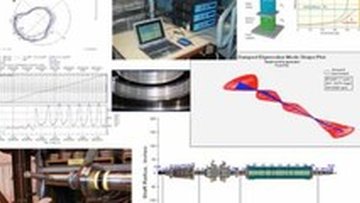
- Recognize, explain, and account for effects of complex rotor dynamics interaction of modes, mode shapes, thermal changes, bearing design, torsional vibration and structural modes by using rotor modeling, actual machine data and case history
- Use standard vibration diagnostic tools on machine-simulating rotor kits through demonstration
- Analyze and discuss case histories that highlight the vibration documentation, analysis and machine malfunction corrective techniques.
Machinery Diagnostics methodology or ISO 18436 Category III.
Bently Nevada™ AMD course has been approved by our partner Mobius Institute. After the course, attendees who complete Mobius Institutes CAT IV online training can take the optional ISO 18436-2 CAT IV exam.
Program Outline
Program
In order to put the theory into practice, this training includes real-life demonstrations and 25 case studies.
- Rotor modeling for machine diagnostics – identify design parameters that determine rotor dynamic behavior – understand the relationship between critical speeds, resonances and natural frequencies
- Anisotropy – recognize machine behavior due to support stiffness anisotropy
- Machine balancing – differentiate between balancing methods such as influence vectors, static/coupled, and polar (modal) – learn about balancing for the thermal bow effect
- Rotor-to-stator rubs – detect machine rubs – uncover how rub condition can show fractional frequency – differentiate between the different types of variable bow effects
- Bearing design (fluid bearings and magnetic bearings)
- Diagnose and mitigation of fluid induced instabilities.
- Shaft cracks – discover symptoms related to shaft crack diagnosis – uncover relationship between cracks, thermal sensitivity and rotor radial vibration
- Gear forces analysis – recognize pros and cons of different gear types – understand normal gear force directions – calculate five discrete gear frequencies
- Torsional vibration measurements and analysis – learn about torsional excitations and the importance of torsional calculations – measure torsional vibration using Time Interval Measurement (TIM) and other methods
- Impact testing and analysis – understand the difference between operating deflection shape (ODS) and mode shape analysis – use impact testing to identify component natural frequencies
- Signal processing – understand the importance of sampling – convert an analog signal to a digital format
Upcoming Sessions
21 Sep
to
25 Sep
Bently Nevada™
Advanced Machinery Dynamics
08:00 AM
-
05:00 PM
(Asia/Dubai)
45h
onsite
Dubai, United Arab Emirates
12 seats left
19 Oct
to
23 Oct
Bently Nevada™
Advanced Machinery Dynamics
08:00 AM
-
05:00 PM
(Europe/Rome)
45h
onsite
Firenze, Italy
10 seats left
Related Courses
1/5

Advanced Machinery Dynamics
Your request has been submitted.
Thank you for your interest. A specialist will be in touch with you shortly.